What Is Kintsugi? The History and Meaning Behind the Golden Seams
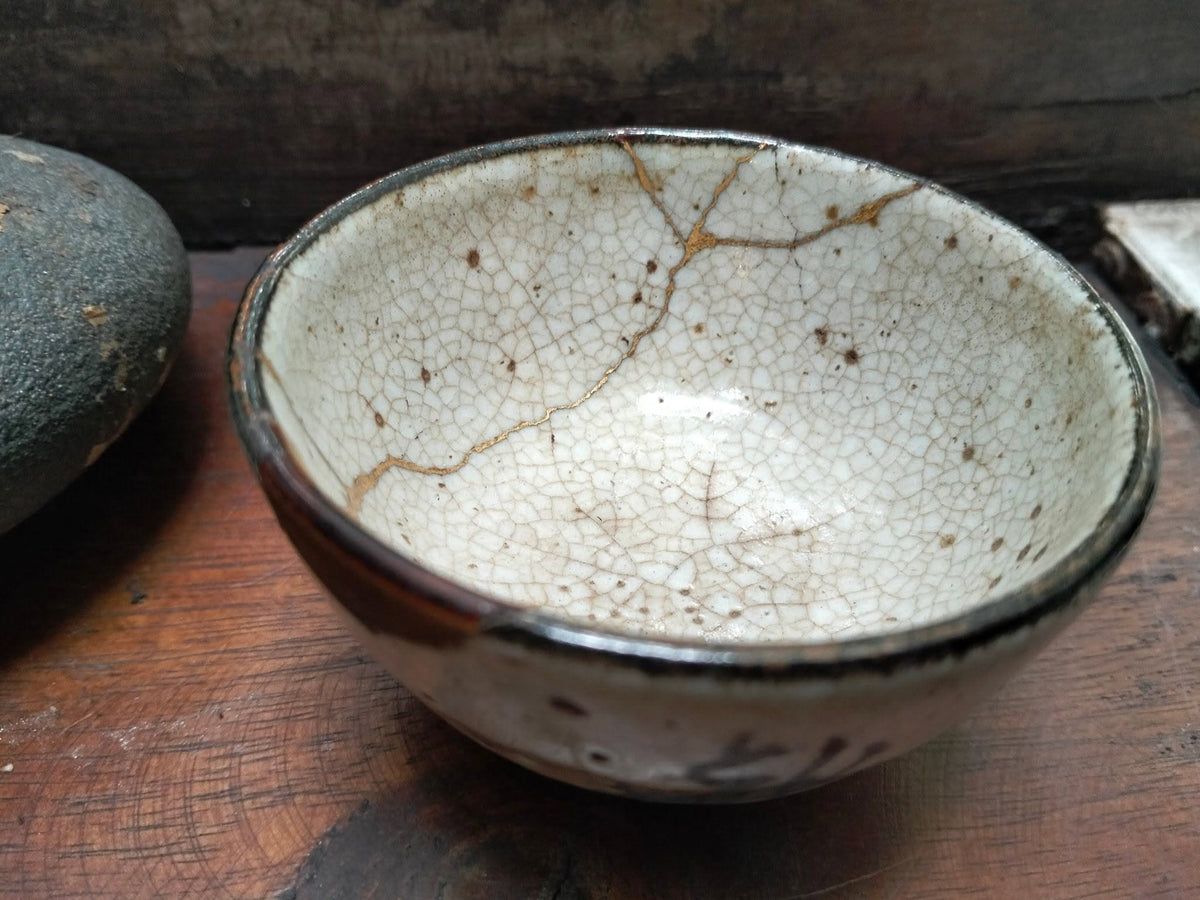
A broken bowl is often treated as though it has reached the end of its life. In Kintsugi, however, the moment of breaking is not the end of the story. The fragments are joined again, the fractures are made visible with gold, and the object returns in a new form—one that neither conceals its past nor pretends to be exactly as it was before.
Kintsugi is therefore both a method of ceramic restoration and a deeply human way of looking at time, loss, and continuity. The beauty of the restored piece no longer depends on an untouched perfection. It lies in the object's ability to carry the marks of experience and continue its life.
What Does Kintsugi Mean?
Kintsugi is written in Japanese as 金継ぎ. Kin means “gold,” while tsugi means “joining” or “mending.” The word can therefore be translated as “golden joinery.” Another term sometimes used is kintsukuroi, meaning “golden repair.”
In the traditional practice, an artisan uses urushi, a natural lacquer made from the sap of the East Asian lacquer tree, to bond ceramic fragments, fill losses, and prepare the surface for its final finish. Gold powder is then applied to a suitable layer of lacquer. Silver and other metal powders may also be used; a repair finished with silver is often called gintsugi.
The defining principle of Kintsugi is not to make the damage invisible. The repaired line remains an important part of the object's new appearance. The Metropolitan Museum of Art describes Kintsugi as the art of repairing broken ceramics with gold lacquer, restoring the object while making it even more precious.
How Did Kintsugi Begin?
The Story of a Shogun and a Broken Tea Bowl
The exact origin of Kintsugi cannot be tied to one securely documented event. Its best-known story takes us to late fifteenth-century Japan and the shogun Ashikaga Yoshimasa.
According to the popular account, one of Yoshimasa's prized Chinese tea bowls broke and was sent to China for repair. When it returned, the bowl had been joined with conspicuous metal staples. This result is said to have encouraged Japanese craftspeople to seek a more refined and visually harmonious method—one that would preserve the vessel while honoring the evidence of its damage.
This story is often presented as the birth of Kintsugi, but it is better understood as a traditional account rather than a fully verified historical event. Louise Cort, curator of ceramics at the Smithsonian's Freer Gallery of Art and Arthur M. Sackler Gallery, has suggested that the practice more likely became established in the late sixteenth or early seventeenth century, alongside the flourishing of Japanese tea culture.
From Practical Repair to an Aesthetic Language
Within the Japanese tea tradition, a bowl is more than a container. Its shape, glaze, traces of the maker's hand, signs of use, and history of ownership all contribute to its value. When a treasured vessel broke, repairing it allowed the relationship between the owner and the object to continue.
Japanese lacquer artisans already possessed highly developed knowledge of urushi and maki-e, a decorative technique in which gold or silver powder is sprinkled over lacquer. By bringing these skills to ceramic repair, they transformed the join itself into a meaningful part of the decoration. Repair was no longer only a way to recover function; it became a creative act.
Surviving museum objects help establish Kintsugi's place in Japanese art history. The Metropolitan Museum of Art holds a thirteenth-century Longquan celadon tea bowl made in China and later repaired with gold lacquer in Japan. The museum notes that the Kintsugi repairs suggest the imported bowl was once used and cherished there.
The Met also holds a seventeenth-century Shigaraki tea jar whose mouth and body were repaired with gold lacquer. Across its deep reddish-brown surface, the repairs form what the museum describes as an intriguing golden “landscape.”
Kintsugi is a Japanese technique, but it was not limited to ceramics made in Japan. Imported vessels from China, Korea, and Vietnam could enter Japanese collections, be used in tea culture, and eventually be restored by Japanese lacquer artisans.
The Meaning of Kintsugi
The Past Is Not Erased
Kintsugi does not return a bowl to the condition it was in before it broke. Instead, it creates a new version in which the event is openly acknowledged. The golden line does not deny the damage; it marks the place where the object was carefully restored.
Every fracture is unique, which means no two Kintsugi works can be completely identical. The pattern is determined by the actual moment of breakage. An artisan is not simply painting an arbitrary gold design onto the surface. The work follows and responds to the history already held within the object.
Beauty in Imperfection
Kintsugi is frequently associated with wabi-sabi, the Japanese aesthetic sensibility that recognizes beauty in simplicity, imperfection, impermanence, and the traces left by time. This connection helps explain why a repair does not always need to be disguised.
However, Kintsugi should first be understood as a specific restoration craft. Its modern associations with emotional healing and resilience are interpretive layers that have grown from the physical practice, especially in recent decades.
Kintsugi does not claim that breaking is beautiful in itself, nor does it romanticize loss. Its deeper value lies in what follows the break: the time, skill, and patience devoted to helping an object once considered unusable enter another stage of life.
A Symbol of Resilience and Renewal
Today, Kintsugi is often used as a metaphor for human experience. Difficult events do not necessarily make a person less worthy. When loss and hardship are acknowledged and tended to, they can become part of one's identity—not the whole identity, but evidence of what has been endured, transformed, and carried forward.
This metaphor is powerful because it does not promise a return to an untouched former state. Healing does not always mean forgetting or becoming exactly who we once were. Sometimes it means learning to live fully in a form that has changed.
Respect for Objects and Craftsmanship
Kintsugi can also encourage a more thoughtful relationship with material things. Instead of automatically discarding a damaged object, we may consider its function, emotional value, history, and potential for repair.
At the same time, Kintsugi should not be reduced to a simple “zero-waste” slogan. Historically, urushi, gold, and the labor of a skilled lacquer artisan were costly. The technique was generally reserved for objects considered worthy of preservation. Sustainability is a meaningful contemporary interpretation, but it was not necessarily the practice's only—or original—purpose.
When a Fracture Becomes Part of the Story
Kintsugi does not ask us to believe that a repaired object is exactly the same as one that has never broken. Its most profound value lies in the opposite truth: the piece has changed, but change has not taken away its dignity.
From a method of restoration within Japanese tea culture, Kintsugi has developed into an aesthetic language recognized around the world. It invites us to look at objects more slowly, value the hand of the artisan, and reconsider the marks that time leaves behind.
A golden seam does not erase a wound. It reveals that where breakage once occurred, an act of care followed.
Share:
Custom Kintsugi Service: Giving Your Beloved Items a Second Life
What Makes Every Kintsugi Piece One of a Kind?